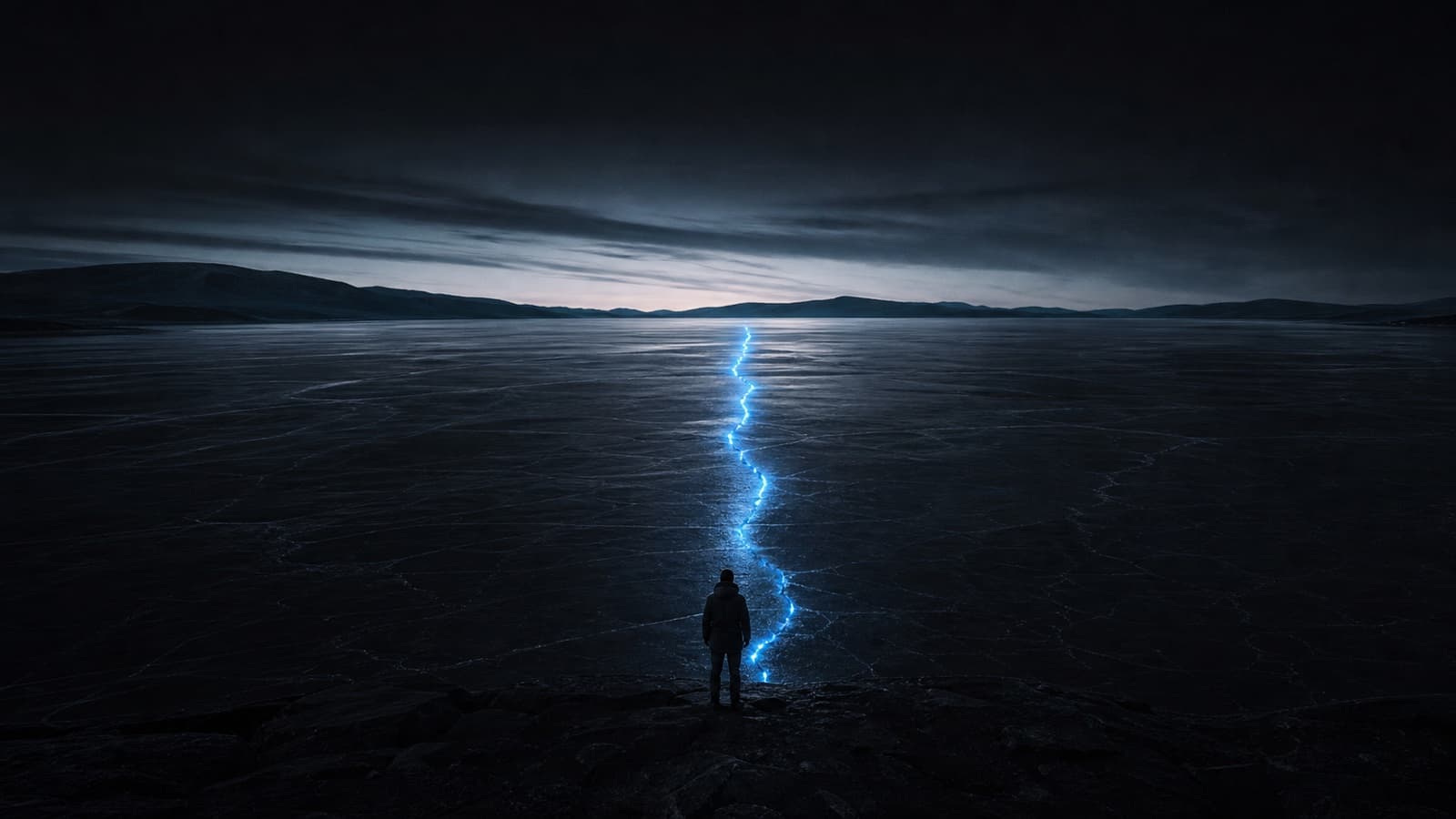
I have stared at an empty editor window for three hours and called it work.
Not metaphorically. I mean the cursor blinking in the top-left corner of a file named, hopefully, index.js, and me very still in front of it, the way you sit very still in front of a dog you're not sure about. I told myself I was thinking. I was architecting. I was holding the whole shape of the thing in my head so it would come out right the first time. What I was actually doing was being afraid, slowly, with good posture.
The blank file is a frozen lake. You came to fish. The fish are real, they're down there, you've caught them before. But between you and them is a sheet of ice so clean and unbroken that walking onto it feels like a kind of vandalism. So you stand at the edge and you study the lake. You consider the lake. You develop, over the course of a productive-feeling afternoon, a rich and nuanced relationship with the lake. And you catch nothing, because the one thing the lake requires of you, you haven't done. You haven't cracked it.
The lie of the clean first move
Here is the thing nobody tells you when they teach you to build: the difficulty is not distributed evenly across the work. It's front-loaded into a single moment — the moment before the first line exists. After that, everything is editing, and editing is comfortable. Editing is a conversation with something that already talks back. But the empty file doesn't talk back. It just reflects you, and what it reflects, at the start, is mostly doubt.
We mistake this paralysis for a planning problem. We think if we just thought harder, sequenced better, drew one more box-and-arrow diagram, the ice would somehow part on its own. It won't. Planning is what the fear wears to look respectable. I have written elaborate architecture documents for projects I never started, and I can tell you with the authority of a man who has done it many times that a perfect plan for an unbuilt thing is just a very tidy way of not building it.
The lake doesn't care how well you understand it. It cares whether you've put a hole in it.
Make something bad on purpose
The only cure I've found, after a few decades of starting things — companies, training programs, software, one novel I'd rather not discuss — is deliberately, almost rudely, making the first version bad. Not bad by accident. Bad on purpose. As a strategy.
You write the dumbest function that could possibly run. You name the variable thing. You hardcode the value you'll obviously have to compute later. You leave a comment that just says // fix this, it's wrong. The point is not to be sloppy; the point is to break the ice. A bad first line converts an infinite problem — what is the perfect thing to build — into a finite one — what is wrong with this specific bad thing in front of me. And the second question your brain is delighted to answer. It has opinions. It was built to criticize. It just couldn't get traction on a surface with no flaws in it, because there was nothing yet to be wrong.
This is why athletes warm up with form they'd be embarrassed to show in the event. You don't open with your max. You open with motion. The first rep is not supposed to be good; it's supposed to exist. I learned this on a track long before I learned it at a keyboard, and it took me an unreasonably long time to notice they were the same lesson.
There's a new toy going around as I write this — a chatbot that will, if you ask it, produce a confident paragraph of code on almost any subject. People are alarmed or delighted, depending on the day. What strikes me is narrower and, I think, more durable than the noise around it. The most useful thing it does isn't being right. It's being first. It hands you a draft so plainly imperfect that your reflex to fix it kicks in before your fear to begin can. It cracks the ice for you. Whether that turns out to matter for the big questions, I don't know yet. But the small, daily tyranny of the blank file — that, I suspect, it quietly ends. We may look back and find the real shift was never about machines that think. It was about never again having to face the empty page alone.
The work was always editing
Once you see the blank file as a frozen lake, the whole rhythm of building rearranges itself. The job stops being produce the right thing and becomes produce any thing, then steer. You stop trying to be a sculptor working from a perfect mental image and become something more like a gardener — you put a wrong seed in the ground precisely so you'll have something to prune.
I've shipped startups whose first commit was an embarrassment and killed beautiful plans that never earned a first commit at all. The pattern is not subtle once you're looking for it. The people who build things are not the ones who think most clearly at the start. They're the ones most willing to be wrong in writing, early, where it's cheap.
So the next time you find yourself in good posture in front of a blinking cursor, mistaking stillness for thought, do the small violent thing. Type the bad line. Name the variable thing. Crack the ice and let the cold water tell you you've finally started.
The fish were never the hard part. The ice was.