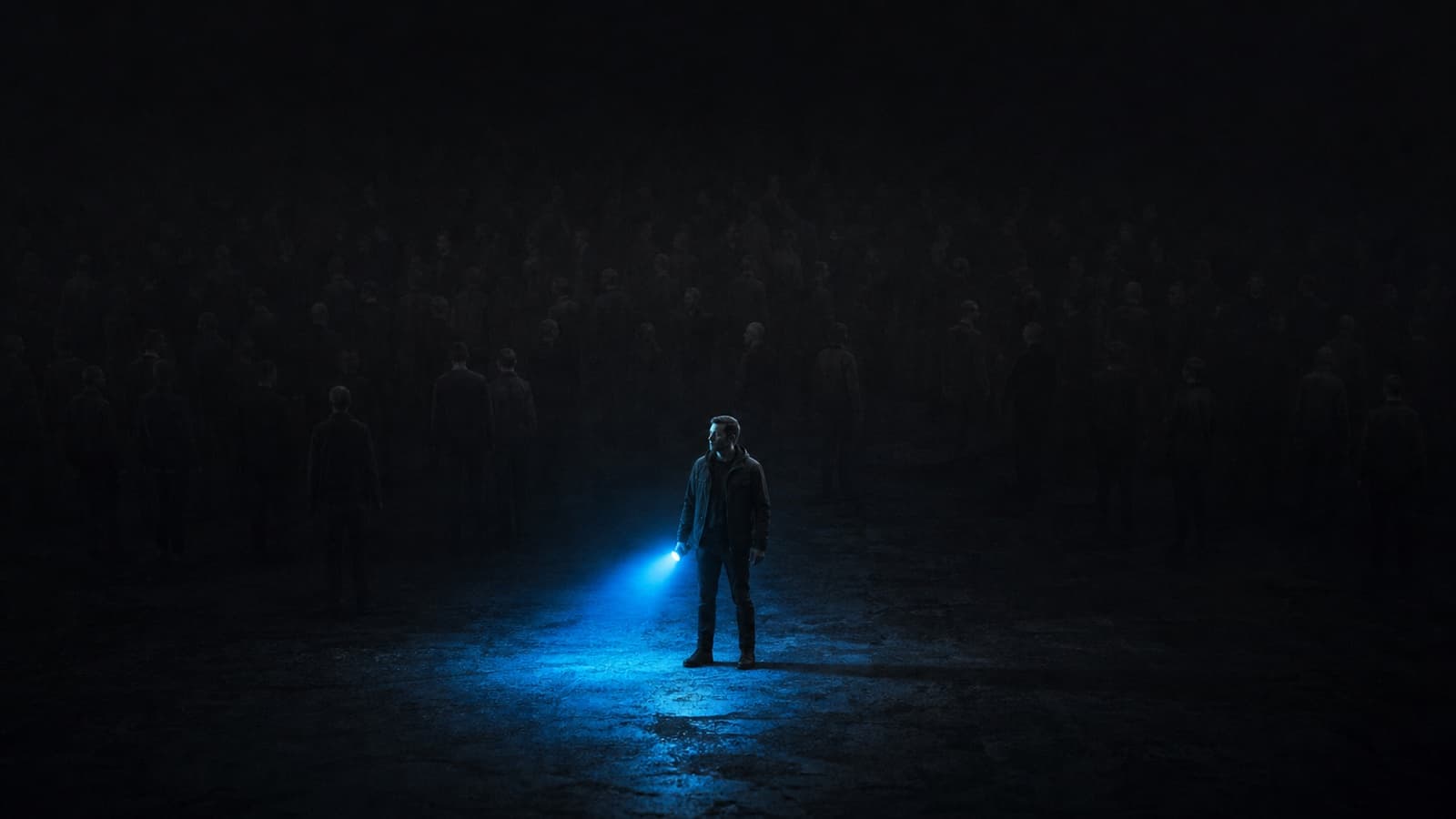
My grandfather set type by hand for a living. The machine that replaced him was, by every measure, better. He was not consoled.
He could read a line of metal upside down and backwards faster than you can read it the right way on a screen. He knew, by feel, the difference between a twelve-point em and an en. For thirty years that knowledge was the whole content of a good day's work, and then over the span of a few he watched it become a hobby. The phototypesetter that took his place was faster, cheaper, and didn't get lead poisoning. It was, on the merits, an improvement. Nobody in their right mind would argue we should still be casting hot metal to print a grocery flyer. And none of that mattered to the specific man at the specific kitchen table, holding a skill the world had just informed him it no longer needed.
I think about him a lot lately, because I build the machines now.
The tide
The easy way to talk about automation is as a rising tide. It's a comforting image, which should be the first warning. The tide lifts all boats. Productivity rises, costs fall, the cheaper good frees up capital for the next thing, and over a long enough horizon everyone is richer. This is not wrong. The horizon really does bend that way. The economists who say so are reading the data correctly.
But a tide does two things, not one. It lifts the boats, and it strands whatever was living on the part of the shore that's now underwater. Same water, same hour, same indifferent physics. The crab does not experience the high tide as enrichment. And the people who narrate automation purely as a lifting force are, almost always, standing on a boat.
I want to be precise about the lie, because it's a subtle one. The lie is not "automation is good." Automation is mostly good, and I'd defend that in front of anyone. The lie is the quiet edit in the sentence — the swap of jobs for people. We say a task was automated. We say a role was eliminated, a function was streamlined, a process was made more efficient. Every one of those words is a tarp thrown over a person. There is no such thing as automating a job. There is only automating around a person who was standing where the job used to be, and then deciding what we think we owe them, if anything, on the way past.
The builder's two stories
A builder gets to tell himself two stories, and he usually tells both at once without noticing the contradiction.
The first story is about agency. I made this. I saw the problem, I designed the system, I shipped it, and now a thing that took four people takes none. This story is full of verbs that belong to him. He is, correctly, proud.
The second story arrives the moment someone asks what happened to the four people. Now the builder discovers a new humility. Well, I don't set hiring policy. The market decides. Technology is neutral. If I hadn't built it someone else would have. I only made the tool. Suddenly the verbs all belong to abstractions — the market, the technology, the inevitable arc of progress. He has become a bystander to his own work.
You cannot have it both ways. You don't get to be the author of the efficiency and a tourist at the consequence. If the cleverness was yours, the displacement is at least partly yours too, and the move of disappearing behind "the market" the instant the bill arrives is not neutrality. It's cowardice with an extra step. The extra step is what makes it feel respectable.
I've done this. I want to be clear that I'm describing a temptation I know from the inside, not one I've watched from across the room. Early on I built something that took a back-office workflow — real people, doing real reconciliation work — and compressed it to something a system did overnight. The demo was thrilling. I remember the feeling exactly: the specific high of watching hours of human effort collapse into seconds. What I did not do was think, with any seriousness, about the three people whose afternoons that work had been. I had a tab open for the gross margin improvement. I did not have a tab open for them. And the thing that should bother you about that — the thing that bothers me — is that it didn't feel like a moral choice at the time. It felt like focus.
That's the real danger. The averted gaze doesn't announce itself as callousness. It announces itself as professionalism.
Neutral is not a real place
The reflexive defense — technology is neutral — is the load-bearing wall of the whole evasion, so it's worth knocking on.
It's true in a trivial sense and false in every sense that matters. A hammer doesn't care whether it builds a house or breaks a window, fine. But nobody ships a hammer in general. You ship this hammer, aimed at this nail, sold to this buyer for this reason, and the reason is almost never mysterious. When a company buys an automation system, the line item it's replacing is usually labor, and everyone in the room knows it, and the deck says "efficiency" because "efficiency" is the word you use when you don't want to say "people." The neutrality of the abstract tool is real. It's just not the thing you actually built. You built a specific lever, pointed at a specific load, and you knew which way it would move.
Here's the part the doom crowd gets wrong, though, because I don't want to be read as joining them. Refusing the lie does not mean refusing to build. The answer to a dishonest optimism is not a fashionable pessimism — the kind that wrings its hands at conferences and then invests in the automation funds anyway. That's the same averted gaze wearing a darker suit. Both the techno-optimist and the professional doomer have found a way to not look at the man at the kitchen table. One looks past him at the horizon. The other looks past him at the apocalypse. He's standing right there in both.
To look at him directly is to hold two true things at once: this should be built, and a real person is going to absorb the cost of it being built. Adults can hold two things. The whole evasion industry exists to spare us from having to.
What "owe" actually means
So what do we owe? Not a fortune. Not a guarantee that the world stops changing — that's not on offer and never was, and my grandfather wouldn't have wanted the pity version of it. The debt is smaller and harder than money. It's mostly attention.
We owe people the truth about what's coming, early, in plain words, while it's still early enough to be useful. The cruelest thing you can do to someone is automate the floor out from under them and let them be the last to find out — to discover their obsolescence in a meeting, framed as a synergy. If you can see the wave from where you're standing — and the builder always can, that's the whole privilege of being the builder — you owe the people in its path the same forecast you'd want.
We owe them a real accounting instead of a euphemism. "We're streamlining the function" is a sentence engineered to have no subject. Name the subject. If three people's work is going away, the honest version says so, to their faces, and treats the transition as a line in the plan rather than an externality that fell off the spreadsheet.
And we owe them the assumption of capacity rather than the assumption of obsolescence. The man who set type by hand was not a typesetting-shaped hole in the labor market. He was a person who had learned one hard craft to mastery, which is the best evidence there is that he could learn another. The waste in displacement is rarely the lost task. It's the trained judgment we throw out with it because we couldn't be bothered to point it somewhere new. The companies that will look least ashamed of this decade, ten years on, are not the ones that automated slowest. They're the ones that treated the people they automated around as the most fluent learners in the building — because they were — and moved them up the ladder of judgment instead of off it.
The receding shoreline
I run a company now, and the thing I am actually selling is the collapse of effort. Agents that do the work a small team used to do. I believe in it. I think the people who own their own automation, rather than rent it from someone who owns it instead, end up freer — that the better future runs through individuals holding the levers, not through a few large hands holding them for everyone. That's a real conviction and I'll keep building on it.
But conviction is not absolution, and I've stopped letting it function as one. The same tide that lifts the customer strands someone the customer used to pay. I don't get to enjoy the first clause and abstract away the second. The most I can do — the most any of us building this can honestly do — is keep the man at the kitchen table in the frame. Not as guilt. Guilt is just self-regard with better PR; it makes the displaced person a prop in your feelings. As accounting. As a line that doesn't fall off the spreadsheet.
The tide is coming in either way. That was never the question. The question was only ever whether the people who saw it first told the people standing on the low ground, or pretended they were only ever building boats.
I knew which kind of man my grandfather was. He'd have told them.