Every expert I admire was once embarrassingly bad at the thing, in public, on someone else's payroll. The surgeon who closed cleanly was, a decade earlier, the resident whose first sutures an attending quietly redid after she left the room. The lawyer who can read a contract the way the rest of us read a menu spent two years as the associate who summarized depositions nobody senior wanted to read. The art director with the unteachable eye started by resizing other people's logos at two in the morning. None of them woke up good. They were bad, on the clock, where the badness was tolerated because everyone understood it was the cost of producing the next generation.
I think about this because I came up the cheap way myself — many careers, mostly self-taught, learning by doing the dull work badly until it stopped being dull or badly done. And I have spent the last couple of years watching software get genuinely competent at exactly that dull work. Not the brilliant work. The dull work. The first draft, the boilerplate, the summary, the cleanup. The work we used to hand to the youngest person in the building because it was beneath everyone else and because doing it was the only known way to stop being the youngest person in the building.
That is the apprentice problem, and almost nobody is naming it correctly.
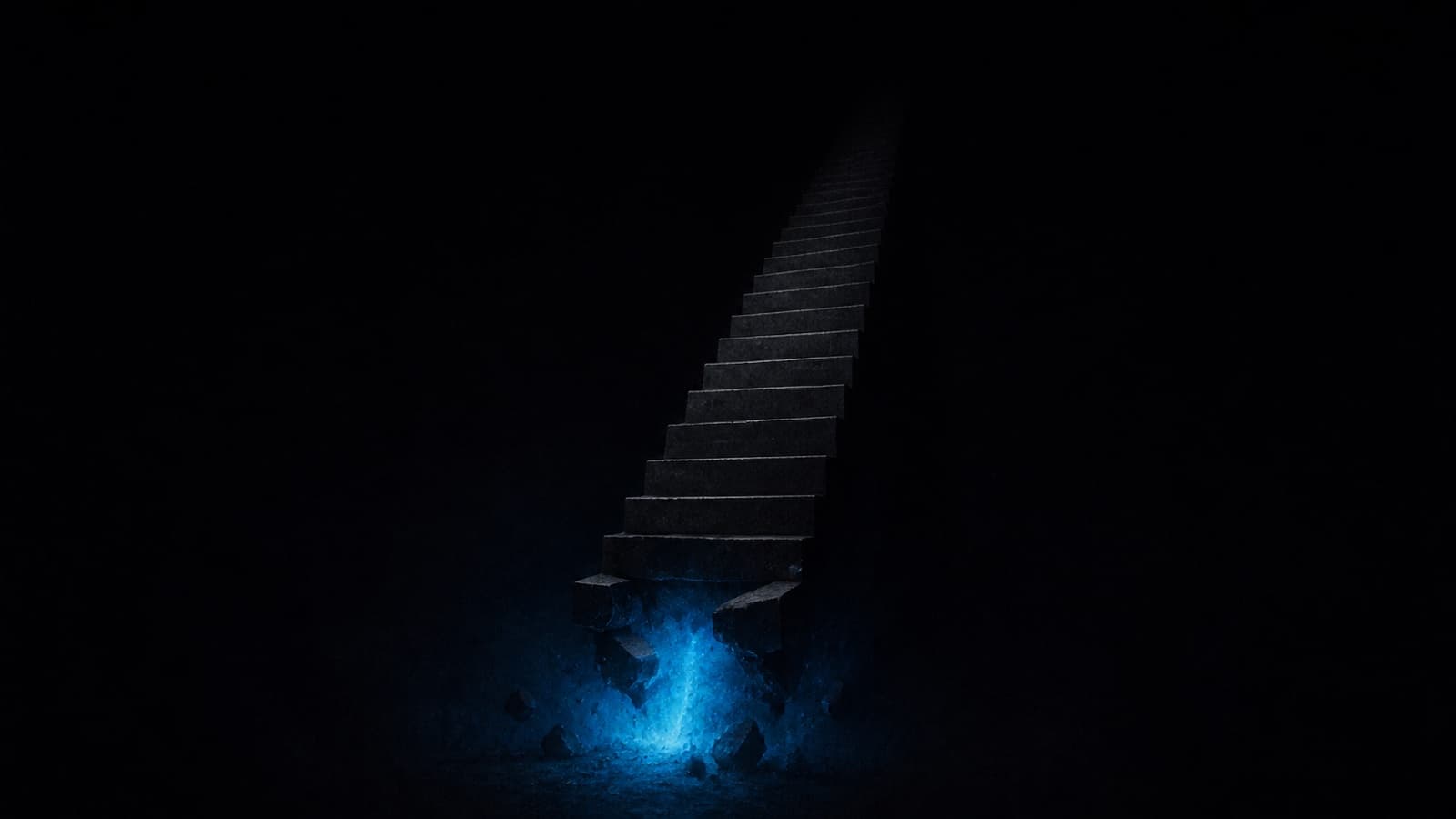
The staircase
Picture expertise as a staircase. You start at the bottom and you climb, one tedious step at a time, and at the top you are the person other people consult. We have always known the staircase was real. What we never examined too closely is that the bottom steps were load-bearing. They weren't a hazing ritual. They were the mechanism. You learned what a good contract looked like by drafting a hundred mediocre ones and watching a partner bleed red ink across them. You learned to write clean code by writing dirty code, shipping it, and being on call when it broke at three in the morning. The tedium wasn't separable from the expertise. The tedium was the expertise, metabolized slowly.
Now imagine someone removing the bottom three steps while people are still standing on them. Not the top of the staircase — the top is fine, the seniors are fine, they already climbed. The bottom. The part where the climb begins.
That is roughly what is happening. The current models — and I am writing this in the summer of 2024, with tools that can produce a competent first draft of almost any document and a working first pass at most code — are very good at the bottom three steps and not yet good at the top. Which sounds like a clean division of labor. The machine does the grunt work, the human does the judgment. Everyone wins.
Except the grunt work was where the judgment came from.
What we're actually optimizing away
Here is the part that should make you sit up. When a firm decides it no longer needs to staff the junior tier, it is making a perfectly rational decision about this quarter and a catastrophic decision about this decade — and the structure of the org chart means almost nobody is incentivized to notice the second one.
The math is seductive. A junior associate costs real money and produces work that needs heavy review. A model costs almost nothing and produces work that needs heavy review. If the review burden is similar, why pay for the human? The honest answer, the one that doesn't fit in a spreadsheet, is that the human review was never only about catching errors in the document. It was about a person learning, over thousands of corrected documents, what "wrong" feels like before they can articulate why. You were not paying the senior to fix the junior's work. You were paying for the junior to be in the room while it got fixed.
Automate the document and you keep the document. Automate the document and you also, silently, cancel the apprenticeship that the document was secretly funding. The output survives. The pipeline dies. And pipelines die quietly — there is no quarter where the dashboard turns red and says you have stopped manufacturing senior people. You find out fifteen years later when you reach for a master craftsman and the bench is empty, because the people who would have been masters spent their twenties supervising machines instead of struggling toward competence.
I want to be careful here, because the easy version of this argument is reactionary, and I don't believe the reactionary version. I am not saying the tools are bad or that we should hand the tedium back to the interns out of nostalgia. The tedium was never sacred. A lot of it was genuinely a waste of a human life — there is no dignity in a person spending six months renaming variables or reconciling spreadsheets that a machine reconciles perfectly. Good riddance to a great deal of it.
What I am saying is narrower and harder. We built our entire system for growing expertise on top of that tedium, the way a town gets built on top of a river. Now we are damming the river for excellent reasons, and we are acting surprised that the town has no water. The tedium was doing two jobs. We only ever paid attention to one of them.
The map is not the territory
There is a tempting answer that I want to take apart, because a lot of smart people are reaching for it. The answer goes: the new junior is the person who supervises the machine. The skill isn't drafting anymore; it's directing and reviewing. We'll just train people to be great editors of machine output instead of producers of their own.
I think this is half right and dangerously incomplete. You cannot reliably judge work in a domain where you have never produced work. Editing is a senior skill that feels like a junior skill. Ask anyone who has tried to manage a function they've never done — they can tell when something is off but they cannot tell why, cannot specify the fix, cannot distinguish the confidently-wrong answer from the correct one when both are fluent. And fluency is precisely what these models are best at. They produce wrong answers in the exact register of right ones. The person who has drafted a hundred contracts smells the flaw in the smooth machine draft. The person who has only ever supervised machine drafts will sign it.
So "supervise the machine" is not a substitute for the climb. It is a skill that presupposes the climb. We are proposing to staff the editor's chair with people who were never allowed to be writers. The map will look fine. The territory will quietly rot.
Designing the new bottom steps
If I'm right that the bottom steps are being kicked out, then the most urgent design problem of this decade is not which tasks to automate. It is how expertise gets grown once its traditional training ground is gone. This is a problem for whoever builds the next generation of firms, and I'll admit it's the question I find myself circling back to most. I suspect the more interesting design is one where AI agents work alongside individual employees rather than replacing the rung beneath them — and the harder I look at the apprentice problem, the more I think that distinction is the whole game.
A few principles, offered as a starting argument rather than a finished answer.
First, separate the two jobs the tedium was doing, and keep the second one on purpose. If junior work was both production and education, and the machine now does the production, then someone has to deliberately fund the education that used to come free. That probably means juniors who redo what the machine did — not to ship it, but to develop the nose. Deliberately inefficient, deliberately, on purpose, the way a medical student still learns anatomy by dissection in an age of perfect scans. We will have to pay for learning that no longer pays for itself in output. Firms that refuse will look more profitable for about a decade.
Second, compress the climb, don't delete it. The staircase doesn't have to take fifteen years. If a junior can watch a master and a machine work the same problem side by side, with the master narrating why, the loop between bad-and-corrected might run far faster than it ever did when you had to wait for a partner to find time. The danger isn't speed. The danger is mistaking the elevator for having no staircase at all.
Third — and this is the part I'd stake real money on — judgment will become the scarce, expensive, defensible thing, precisely because we will have stopped manufacturing it by accident and will have to manufacture it on purpose. For a generation, expertise was a free byproduct of getting work done. It is about to become a deliberate, costly, intentional product. The organizations that figure out how to grow seniors when the junior work has evaporated will own something nobody can prompt their way into. Everyone will have the machine. Almost no one will have the people who can tell when the machine is confidently wrong.
The thing worth saying plainly
I started by saying every expert I admire was once bad in public on someone's payroll. I'll end on the worry underneath that. We are very close to a world where no one is allowed to be bad in public anymore, because the machine is always available to be fluent instead. And a world that never tolerates visible badness is a world that stops producing greatness, because greatness was always just badness that someone paid to keep around long enough to ripen.
The staircase is being rebuilt whether we attend to it or not. The only question is whether we design the new bottom steps deliberately, while we can still remember what the old ones were for — or whether we wake up at the top one day, turn around to call the next person up, and find there's no one on the stairs.