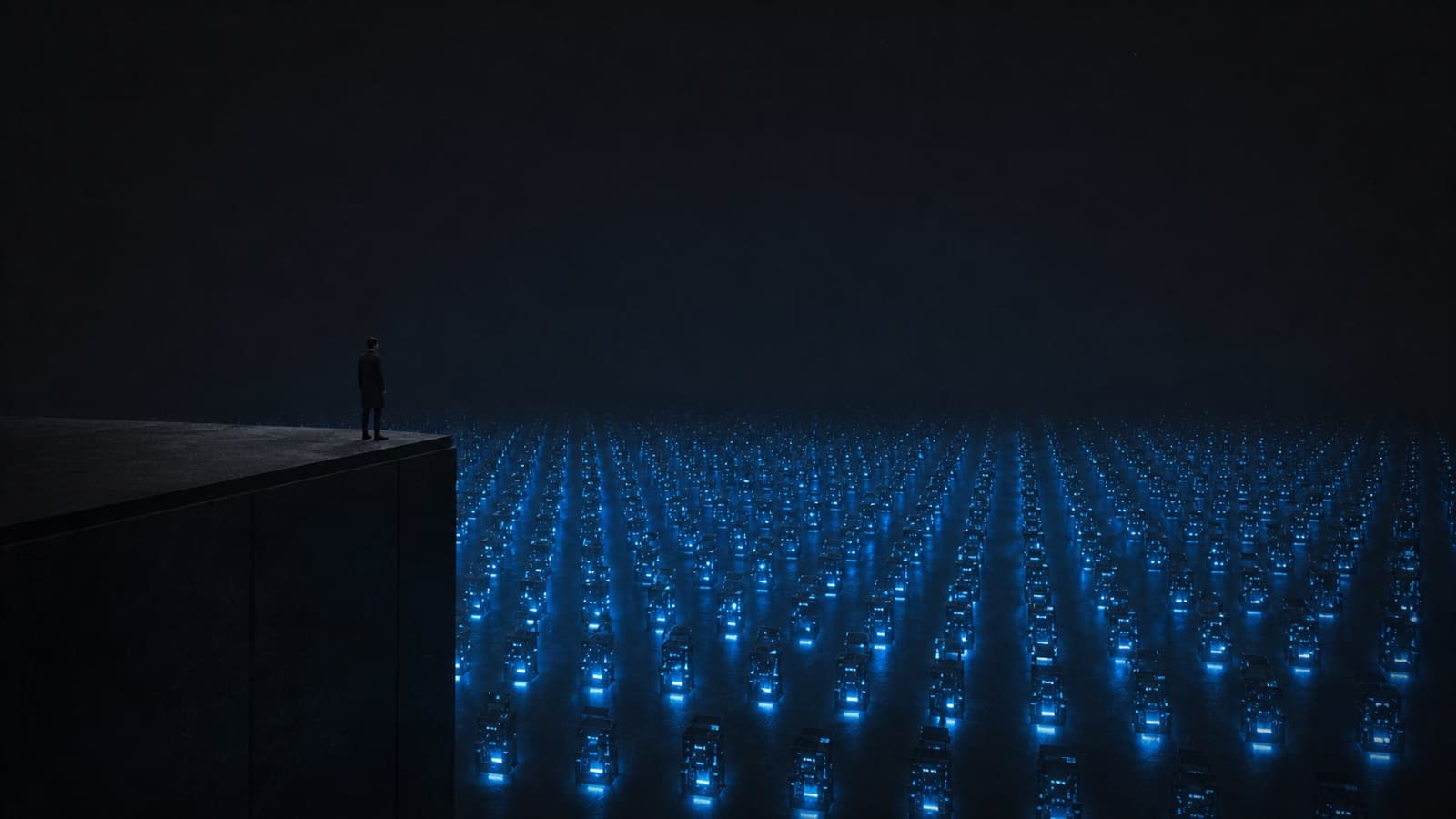
Someone asked me how many people work at my company. The honest answer required a long pause and a definition of work.
I could give the number that fits on a cap table — small enough that I can picture every face, name every kid, recall who takes their coffee black. That number is true and it is not the answer. Because most of the doing at my company is not done by those faces. It is done by agents: software that reads, drafts, reconciles, schedules, files, and increasingly decides, running in the seams between the people, at three in the morning when the people are asleep. If you counted by hands on keyboards I run a tiny company. If you counted by tasks completed before lunch I run a large one. The questioner wanted a single integer. I gave him a pause, and then I gave him the truth, which is that I no longer know how to count it, and that not knowing is the most interesting fact about my job.
For most of my working life I thought of building a company the way a child thinks of a watch — as a thing made of gears. You found the right parts, you set them in the right relation, you wound the spring, and if you had assembled it correctly the hands moved. A founder, in that picture, is a clockmaker. He specifies the mechanism. Every department is a gear sized to mesh with the next. The org chart is the exploded diagram. When something runs slow you open the case and find the gear that is binding and you file it down or replace it. I spent years being a competent clockmaker. I was proud of my clocks. I could open one and tell you, to the tooth, why it kept the time it kept.
The clock is the wrong machine now. I have come to think the right image is not a machine at all. It is a garden.
The clockmaker's reflex
Let me be fair to the clockmaker, because I was one and I have affection for the trade.
The clock model was not a delusion. It was an adaptation to a real constraint. When your company is made of people, and people are expensive and slow to onboard and capable of only so much at once, you cannot afford much slack. You specify roles tightly because each role costs a salary and you need to know what you are buying. You write the process down because the process is how you move knowledge from the head that has it to the head that needs it without losing too much in transit. You build the gear train because the gear train is the cheapest way to make a fixed number of expensive hands cover a growing amount of work. Hierarchy, headcount plans, the quarterly cadence — these are not vanity. They are what you do when your parts are scarce, costly, and irreplaceable on short notice.
The clockmaker's deepest reflex is specification. Tell each part exactly what to do. Reduce ambiguity, because ambiguity in a person is risk: the new hire who guesses wrong, the contractor who builds the thing you described instead of the thing you meant. A good operator becomes very good at removing the spaces where a person might guess. We call it being clear. We call it good management. It is, mostly, a defense against the cost of a bad guess made by a part you cannot easily swap.
Now change the parts. Suppose the doing is mostly done by agents — cheap to instantiate, fast to redirect, willing to work all night, and, crucially, capable of holding far more context than any single human and acting on it without being walked through every step. The constraint that justified the gear train just lifted. And the reflex that the constraint trained into me — specify everything, remove every space where a part might guess — turns out to be exactly the wrong reflex for the new parts. Because the whole value of an agent that can reason is in the guessing. Spend it on a script and you have bought a Ferrari to sit in traffic.
Why you cannot wind it
I learned this the way I learn most things, which is by doing the obvious thing and watching it fail.
When we first put agents to real work, I managed them like gears. I wrote them long, exact instructions. Do this, then this, then this; if you see X, do Y; never do Z. I was specifying a mechanism, because that is what I knew how to do. And the agents followed the instructions beautifully, right off the edge of every situation I had failed to anticipate. The world, it turns out, is mostly situations you failed to anticipate. A customer phrased something three degrees off from my examples and the agent, dutifully literal, produced confident nonsense. I had built a clock, and the clock kept perfect time in a universe that did not exist.
So I did more of what had failed, which is the clockmaker's other reflex — when the mechanism breaks, add a gear. More rules. More guardrails specified as instructions. The instruction files swelled. They became their own little bureaucracies, and like all bureaucracies they were excellent at handling the last problem and helpless before the next one. I was hand-winding a thing that was supposed to run on its own, and the winding was now most of my day. I had automated the work and kept all the management. This is the trap, and I suspect a great many companies are about to walk into it with their eyes open, because it feels like diligence.
The thing that broke the pattern was small and a little humbling. I stopped writing instructions for one task and instead wrote down what good looked like — what a right answer had in it, what a wrong one smelled of, where the genuine traps were and why they were traps — and then I let the agent find its own way there. It did. Not by following my path; it didn't have my path. By understanding the destination well enough to route to it through terrain I had never mapped. That is not a gear meshing with a gear. That is a seed finding the light.
You do not wind a garden. You do not specify, leaf by leaf, the shape a tomato plant will take. You prepare the soil, you decide where the light falls, you put a fence where the deer get in, and then you let the plant do the one thing a plant is actually good at, which is grow toward what it needs. The gardener's authority is real but it is indirect. It works on conditions, not on outcomes. And the strange part — the part that took me a year to feel in my hands rather than merely understand — is that the indirect authority produces better outcomes than the direct kind, precisely because it leaves room for the plant's own intelligence, which is finer-grained than mine and present in places I am not.
What the gardener actually does
This sounds like an abdication. It is the opposite. The gardener works harder than the clockmaker; he just works on different things.
The clockmaker's effort goes into the mechanism — the gears, the meshing, the exact instruction. The gardener's effort goes into the conditions under which good growth becomes likely. Soil, light, water, and edges. Let me translate those out of the metaphor, because the translation is where the real work lives.
Soil is context. An agent reasons only as well as the ground it is rooted in — the real state of the company, the actual customer, the genuine constraints, kept current and kept honest. Most of what used to be my management instinct now goes into curating that ground: making sure the agents are rooted in what is true today and not in last quarter's fossil. A clockmaker hoards context in his own head and doles it out. A gardener spreads it thin and even, everywhere the roots reach, because he has learned that intelligence starved of context produces confident nonsense, and intelligence fed on good context produces things that surprise him.
Light is direction — the goal, stated as an end-state worth growing toward, not as a route. This is the discipline I was worst at, coming from the clock trade. I wanted to specify the path because the path was where I felt in control. The gardener gives up the path and keeps the destination, and that trade is harder than it sounds, because it means tolerating a plant that grows in a shape you did not picture, and trusting that the shape is good because the light was right.
Water is iteration — the rhythm of feedback. You do not flood a garden once and walk away. You return, you check, you adjust, and the adjustment is small and frequent rather than large and rare. The old quarterly cadence was a clockmaker's cadence, the rhythm of a thing wound and left. Agents run continuously, so the feedback has to run continuously too, and a lot of my week is now spent in that smaller loop — reading what grew overnight and nudging, not rebuilding.
Edges are the guardrails — the fence, the trellis, the line past which growth is not allowed to go. This is where authority concentrates now. I no longer specify what an agent does. I specify, with great care, what it must never do, where the irreversible decisions live, what gets escalated to a human and why. A fence is cheap and a fence is absolute, and a good fence around a free interior is a far better tool than a thousand instructions trying to micromanage the interior into safety. Most of the catastrophes I worry about are fence failures, not growth failures. So that is where I spend the worry.
There is a temptation, watching all this, to conclude that the future founder is a kind of nervous overseer of a swarm, eternally tuning prompts, a glorified gardener in the diminishing sense of the word — somebody who potters. That is the easy version of the thought and it is wrong, in the same embarrassing way that "the org chart dies and everyone becomes a free agent" is wrong. The pottering image misses the weight of the four conditions. Getting the soil right is a strategic act. Choosing where the light falls is the entire job of deciding what the company is for. The fence is where ethics and survival live. None of that is pottering. It is the founder's oldest work, finally stripped of the clockwork that used to disguise it as something else.
What survived the translation
Here is the discovery that reassured me, and it is the one I would hand to anyone standing where I stood.
When I changed machines, I expected to lose everything I had learned about leading people. The tactics, it turned out, did not survive — the one-on-one, the performance review, the careful sequencing of who learns what when, the motivational arts. You do not motivate an agent. You do not worry it is bored, or jealous of the agent in the next process, or quietly updating its résumé. A great deal of what management taught me to do was, I now see, the overhead of working with parts that have feelings and fatigue and politics. That overhead is simply gone, and I do not miss the parts of it I thought were the job.
But the virtues survived. Every one of them, translated.
Judgment survived — it just moved. It used to live in the moment of decision; now it lives in the moment of designing the conditions under which decisions get made. Same faculty, applied one level up. Clarity survived — it is more important than ever, only now I aim it at goals and fences rather than at steps. Integrity survived hardest of all, because a system that reasons on its own will faithfully amplify whatever values you actually built into the soil and the edges, as opposed to the ones you put in the handbook. You cannot fake your way past an agent the way you can fake your way past a quarterly review. It does what your conditions imply, relentlessly, at scale, all night. If your real priorities are ugly, the garden will grow ugly, fast, and in public.
That last fact is the one I would put in front of every founder about to do this. We used to be able to hide the gap between our stated values and our operating ones inside the friction of human organizations — the gap got absorbed by people quietly doing the right thing despite us, or quietly doing the wrong thing slowly enough that we could correct it. A company run mostly by agents has far less of that forgiving friction. It executes your conditions. So the conditions had better be conditions you would be proud to have grow. The leverage that makes a small founder run a large company is exactly the leverage that makes a careless founder a large problem. The garden does not check your character. It expresses it.
What I notice when the metaphors fall away
I distrust my own grand claims, so let me set this one down and tell you the plainest thing I've got — the observation I'd still believe even if the garden talk turned out to be hot air.
What I actually notice, day to day, is quieter than any of this. It is that I have stopped feeling like the smartest part of my own company, and I have stopped minding. The clockmaker has to be the smartest gear; the whole mechanism is his cleverness, externalized. The gardener does not have to be smarter than the garden, and is in fact happier when he isn't. My agents routinely arrive at things I would not have, by routes I could not have specified, because I gave them good ground and clear light and a firm fence and then got out of the way. The first few times this happened it stung a little. Now it is the part of the work I like best — the part where I have built conditions good enough to produce results I did not author.
That is a different relationship to a company than I have ever had. For thirty years I measured myself by what I could personally make the machine do. Now I measure myself by what the conditions I set in motion can do without me in the room. It is less ego and more leverage, and the trade has made me, I think, a better founder and an easier person to be around at dinner.
So when someone asks me how many people work at my company, I have stopped reaching for the integer. The honest answer is that the company is no longer a number of workers. It is a set of conditions, tended daily, inside which a quantity of judgment I cannot easily count goes looking for the light. My job is to keep the soil honest, the light fixed on something worth growing toward, the water steady, and the fences exactly where the irreversible things live. Everything else, I let grow.
The clockmaker asks: did I build the mechanism right? It is a question you can answer once and be done. The gardener asks a question you never finish answering, and it is the only one that matters now. Not what did I build — but what conditions did I set, and is what's growing in them something I'd be willing to put my name on?
Tend that question. The rest finds its own form.